AWS Unveils CloudFormation Express Mode, Revolutionizing Infrastructure Deployment Speeds for Developers and AI Tools.

Amazon Web Services (AWS) has announced the launch of AWS CloudFormation Express mode, a significant enhancement designed to drastically accelerate infrastructure deployments. This new deployment mode aims to empower developers and AI tools by completing CloudFormation operations when resource configurations are applied, rather than waiting for lengthy stabilization checks, promising up to four times faster deployment times for iterative development and specific production scenarios. The introduction of Express mode underscores AWS’s commitment to enhancing developer experience and adapting to the evolving demands of modern cloud-native development, particularly with the increasing integration of artificial intelligence in infrastructure management.
The Evolution of Infrastructure as Code and the Need for Speed
Infrastructure as Code (IaC) has become a cornerstone of modern cloud architecture, enabling organizations to manage and provision their AWS resources through declarative configuration files. AWS CloudFormation, a pioneering service in this domain, allows users to define their desired infrastructure state using templates, which CloudFormation then provisions and manages. This approach brings immense benefits in terms of consistency, version control, automation, and reduced manual errors. However, a persistent challenge within IaC workflows, particularly during development and testing phases, has been the time taken for deployments to complete.
Traditional CloudFormation deployments, known as Standard mode, involve a multi-stage process. After resources are provisioned and their configurations applied, CloudFormation performs extensive stabilization checks. These checks are crucial for ensuring that resources are not only provisioned but also fully operational, ready to serve traffic, and integrated within the broader AWS ecosystem. For critical production deployments where immediate operational readiness is paramount, these stabilization checks provide a vital safety net. They confirm that a database is accessible, a load balancer is routing traffic correctly, or a serverless function is callable before marking the deployment as complete.
However, in many development and testing contexts, this comprehensive stabilization process can introduce significant delays. Developers iterating on infrastructure configurations, testing individual components, or utilizing AI-assisted tools for infrastructure generation often do not require full stabilization confirmation to proceed to the next step. The wait times, sometimes extending to several minutes or even tens of minutes for complex resources, can hinder agility, break concentration, and slow down feedback loops, thereby impacting overall developer productivity. The rise of AI in infrastructure development, which thrives on rapid iterations and immediate feedback to refine generated code or configurations, has further amplified the demand for quicker deployment cycles.
Deconstructing CloudFormation Express Mode: How It Works
CloudFormation Express mode addresses this specific pain point by altering the completion criteria for a deployment. Instead of waiting for resources to achieve full operational stabilization, Express mode marks a deployment as complete as soon as CloudFormation confirms that the resource configuration has been successfully applied. This fundamental shift allows developers and automated systems to move forward with subsequent tasks much faster.
The core distinction lies in when the deployment signals completion, not how the underlying resources are provisioned. Resources still undergo the same provisioning process and eventually stabilize in the background. CloudFormation Express mode is engineered with built-in resilience to manage potential timing issues. If dependent resources encounter transient failures during their background stabilization, CloudFormation automatically retries these operations within the same stack, eliminating the need for manual intervention. This proactive handling of temporary inconsistencies ensures a smoother experience even when deployments complete before all resources are fully stabilized.
Consider the practical implications: in a standard deployment, creating an Amazon Simple Queue Service (SQS) queue paired with a dead-letter queue (DLQ) might take approximately 64 seconds. With Express mode, this operation can complete in as little as 10 seconds. Even more dramatically, deleting an AWS Lambda function with an associated network interface attachment, a task that could previously span 20 to 30 minutes in Standard mode due to complex network resource de-provisioning and stabilization, can now conclude in roughly 10 seconds. These significant time reductions, multiplied across numerous daily deployments for a development team, translate into substantial gains in efficiency and responsiveness.
Key Use Cases and Target Audiences
Express mode is specifically tailored for scenarios where rapid feedback and iterative development are prioritized over immediate, full operational readiness. The primary beneficiaries include:
- Iterative Development Workflows: Developers frequently modify and redeploy small pieces of infrastructure during the development cycle. Whether it’s tweaking an IAM policy, adjusting a Lambda function’s environment variables, or modifying a database parameter, these changes can now be tested and validated much faster. This encourages experimentation and reduces the cognitive load associated with long waiting periods.
- Testing Individual Application Components: In a microservices architecture, teams often need to deploy and test individual services or components in isolation. Express mode allows for quicker spin-up and tear-down of these test environments, streamlining continuous integration and continuous delivery (CI/CD) pipelines by accelerating the infrastructure provisioning stages within automated tests.
- AI-Assisted Infrastructure Development: With the advent of large language models (LLMs) and other AI tools capable of generating infrastructure code, the speed of feedback becomes critical. AI models can iterate on suggested configurations, deploy them rapidly via Express mode, receive quick feedback on successful application, and then refine their output. This sub-minute feedback loop is essential for building effective AI agents that can autonomously manage and optimize cloud infrastructure. Tools like Kiro, for instance, are poised to leverage this capability to provide developers with near real-time infrastructure generation and deployment.
- Production Scenarios with Eventual Stabilization Tolerance: While generally not recommended for immediate traffic shifting, there are specific production scenarios where an organization might be comfortable with resources stabilizing in the background, especially if subsequent deployment steps or health checks are in place to confirm full readiness. This could apply to certain types of resource updates or additions that don’t immediately impact critical user-facing services.
Getting Started: Activating CloudFormation Express Mode
Activating Express mode is straightforward and requires no changes to existing CloudFormation templates, making it immediately accessible to a vast user base. Users can enable Express mode through various AWS interfaces:
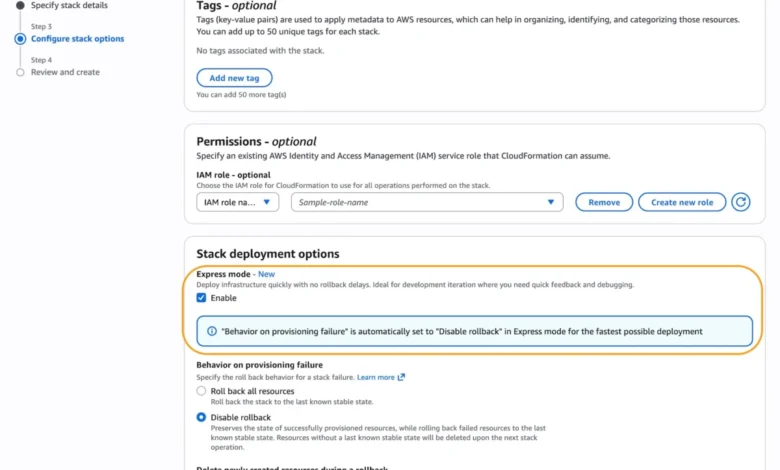
- AWS Management Console: When creating a CloudFormation stack, users will find a new "Express mode" option under "Stack deployment options." A simple toggle allows them to enable this accelerated mode.
- AWS Command Line Interface (AWS CLI): For programmatic control, the
--deployment-configparameter can be set toEXPRESSwhen usingcreate-stack,update-stack, ordelete-stackcommands. For example:aws cloudformation create-stack --stack-name my-app --template-body file://template.yaml --deployment-config '"mode": "EXPRESS", "disableRollback": true'By default, Express mode disables rollback for the fastest iteration experience. However, for production environments where maintaining stack stability is crucial, users can re-enable rollback by setting
disableRollbacktofalsein the deployment configuration. This provides flexibility, allowing users to balance speed with safety as per their specific needs. - AWS SDKs: Developers can integrate Express mode activation directly into their applications or custom tools using the AWS SDKs for their preferred programming languages.
- Infrastructure as Code (IaC) Tools: Popular IaC frameworks like AWS Cloud Development Kit (CDK) offer direct support. Developers can deploy their CDK stacks using the
cdk deploy --expresscommand, which internally utilizes CloudFormation Express mode for provisioning. This seamless integration ensures that CDK users can benefit from accelerated deployments without complex configuration changes. Other AI tools that interact with CloudFormation APIs can also adopt this mode.
The example provided illustrates an incremental infrastructure build, a common development pattern where resources are added one at a time. Deploying an IAM role, then adding a Lambda function, and finally an SQS queue and event source mapping, each step benefits from the rapid feedback provided by Express mode. It is crucial, however, to ensure that IAM role templates adhere to the principle of least privilege, even in accelerated development cycles, to maintain security best practices.
CloudFormation Express mode is fully compatible with all existing CloudFormation templates and supports advanced features such as change sets, which allow users to preview proposed changes before applying them, and nested stacks, where a stack can create and manage other stacks. When Express mode is enabled on a parent stack, all its nested stacks automatically inherit and utilize Express mode, simplifying the management of complex, multi-stack architectures. It’s important to reiterate that for scenarios where resources must be fully operational and validated before proceeding with traffic routing or critical testing, the default Standard mode, with its comprehensive stabilization checks, remains the recommended approach.
Broader Implications and Strategic Impact
The introduction of AWS CloudFormation Express mode is more than just a performance improvement; it represents a strategic move by AWS to further optimize the developer experience, facilitate the adoption of AI in cloud operations, and solidify CloudFormation’s position as a leading IaC tool.
Enhanced Developer Productivity and Agility
The most immediate and tangible benefit is the significant boost in developer productivity. By drastically reducing wait times, Express mode allows developers to maintain flow state, iterate more rapidly, and experiment freely with infrastructure configurations. This acceleration fosters a culture of continuous learning and improvement, enabling teams to deliver features faster and respond to changes with greater agility. In a competitive technology landscape, the speed at which a development team can innovate directly impacts an organization’s success.
Accelerating AI-Driven Cloud Management
The synergy between Express mode and AI tools marks a pivotal development. AI models, whether used for generating infrastructure code, optimizing existing configurations, or even self-healing infrastructure, rely heavily on quick feedback loops to learn and refine their actions. Express mode provides the necessary speed for these AI agents to deploy proposed changes, observe outcomes (even if not fully stabilized), and then adjust their strategies. This could pave the way for more sophisticated, autonomous cloud management systems that can react and adapt to operational demands in near real-time, reducing the burden on human operators and potentially unlocking new levels of efficiency and resilience. The mention of AWS MCP Server and plugins for AI tools further highlights AWS’s intent to support this integration.

Streamlining CI/CD Pipelines
Continuous Integration and Continuous Delivery (CI/CD) pipelines often involve multiple stages of infrastructure provisioning for testing, staging, and production environments. Express mode can significantly shorten the infrastructure deployment phases within these pipelines, leading to faster build times, quicker test cycles, and ultimately, more frequent and reliable software releases. This contributes to a more robust and efficient DevOps culture.
Cost Efficiency
While not directly a cost-saving feature in terms of AWS resource usage, faster deployments indirectly lead to cost efficiencies. Reduced developer waiting times mean less wasted human capital. Quicker iteration cycles can also mean that temporary test environments are spun up and torn down more rapidly, potentially reducing the duration for which resources are active, albeit in small increments. Over time, these small savings can accumulate.
Reinforcing CloudFormation’s Position
In an ecosystem with various IaC tools, including third-party offerings, AWS’s continuous innovation in CloudFormation ensures its relevance and competitive edge. By addressing a long-standing customer pain point, AWS demonstrates its responsiveness to user feedback and its commitment to evolving its foundational services. This enhancement ensures CloudFormation remains a compelling choice for managing AWS infrastructure, even for the most demanding and dynamic workloads.
Availability and Future Outlook
AWS CloudFormation Express mode is currently available in all AWS commercial Regions at no additional cost, making it immediately accessible to a global user base. This broad availability ensures that developers worldwide can begin leveraging its benefits without regional restrictions. For detailed information on regional availability and future roadmaps, users can consult the AWS Capabilities by Region page. Comprehensive documentation is also available on the CloudFormation user guide, providing in-depth instructions and best practices for implementing Express mode.
AWS encourages users to provide feedback on Express mode through AWS re:Post for AWS CloudFormation or via their usual AWS Support contacts. This ongoing dialogue with the developer community is crucial for the continuous improvement and evolution of AWS services.
The introduction of CloudFormation Express mode represents a significant stride forward in cloud infrastructure management. By prioritizing speed and agility for iterative development and AI-driven workflows, AWS is not only enhancing the daily lives of developers but also laying groundwork for a future where cloud infrastructure is more dynamic, responsive, and intelligently managed. This innovation reflects a broader industry trend towards accelerating every facet of the software development lifecycle, ensuring that the infrastructure layer can keep pace with the rapid demands of modern applications and intelligent systems.